

Sunrise at the Studio Board Game Review
Pencil First Games has made some of our favourite little cards games we’ve ever played and so when they sent over Sunrise at the Studio over for us to review, we were really excited. With a great track record of releasing great games, we knew that at the very least, this would be a clever game with some great ideas. Would it work for us, though? Let’s take a look!

In Sunrise at the Studio, players will be using cards from their hands to complete projects on the table. Each turn begins with choosing how you want to work that turn, and this will determine the number of cards you keep and the number of cards you pass along or discard. The trick is you’ll be pushing your luck based on the hand you draw, because you will perform all three actions before clearing you mat (keep 3 and pass 1, keep 2 and pass 2, etc). You will receive cards from other players as well, and eventually you will use these cards to complete some projects. Each time you pass and keep cards, you will deal with the cards you are left with, adding tokens to projects for cards that match, or discarding cards you cannot use to get potential future resources. As you complete projects, you’ll add them to your score pile and trigger abilities tied to completing projects. Each day of the game will have you getting, passing and using cards three times. After 3 days, the game ends.
There are a lot of moving parts in Sunrise at the Studio to consider, but they all work well together. Our how to play above was quite brief and didn’t cover nearly everything you’ll do, but rather laid out the basics of the game. On top of drafting and passing cards and completing projects, you’ll also work towards studio goals that will get you end game points. You can get end game personal scoring cards as well as a reward for finishing a project, and those will help drive your strategy as you move into day 2 and day 3.
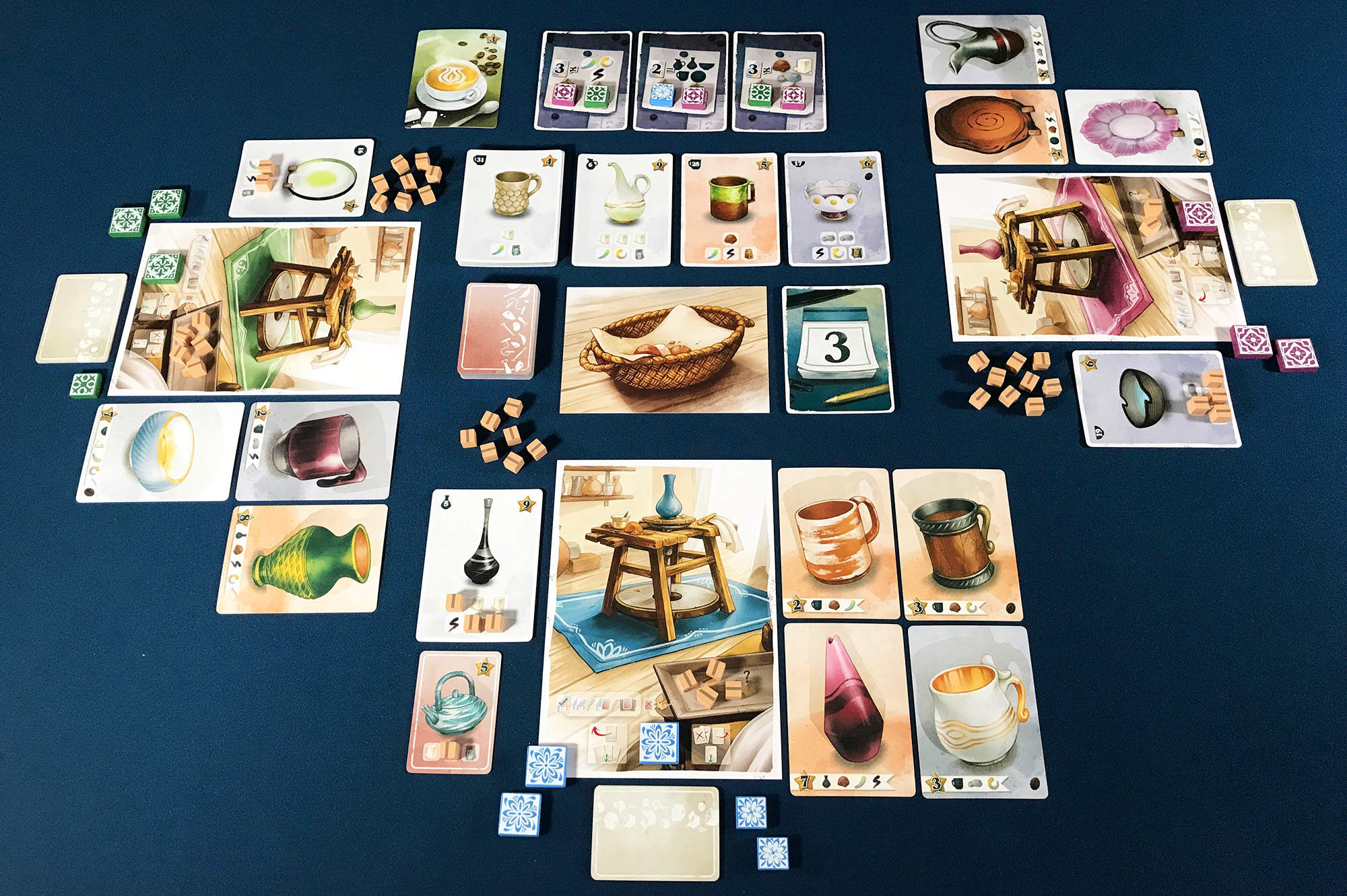
I really love this idea of forcing players to pass cards to other players. and also love that even if you cannot use a card on a turn, it’s not a complete waste as you get to place a resource in your player mat tray to eventually trade 2-for-1 to help complete a project later. Ongoing projects are public, though, so keeping tabs on what other players are doing will be important. Ideally you are passing them items they cannot use completely, which limits the amount of projects they can complete. It is minor player interaction to be fair, but even this minimal player interaction is better than games where it feels like everyone is just doing their own thing. Pencil First Games is great at doing this in their games, which is why we enjoy them so much.
This is a sprawling game once you get to higher player counts, so make sure you have space for it. There is physically a lot of game in this small box, but gameplay wise as well, I think you get more out of this than you would expect from a box this big. I like that this is a bit more difficult than other Pencil First Games, yet still being easy enough and fast enough to be approachable for all kinds of players. There are a few elements here that feel mechanically familiar, with lots of things you’ve seen before. That doesn’t make this bad, but might have less of an impact on long-term board game players. Still, I think this is worth checking out, especially if you need an easy-to-teach filler game for board game night!

