

Shallow Seas Board Game Review
Anytime Bad Comet releases a new board game, I’m instantly going to be interested. I’ve loved absolutely everything this company has put out, to the puzzled Wild Serengeti to the tile and animal laying game Life of the Amazonia. Shallow Seas is definitely the lightest game from Bad Comet, but that doesn’t make it bad. If you are looking for something like Cascadia but with a bit more depth, I think this might be it.
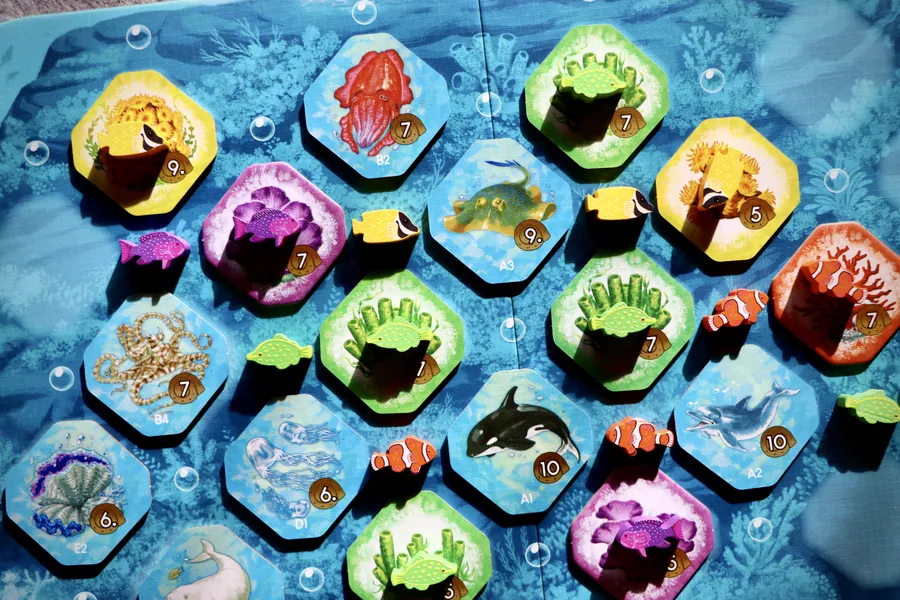
In Shallow Seas, players will be drafting tiles and fish from the center of the table and placing them within their reef. There are two types of tiles, coral and sealife. Coral tiles provide players points by surrounding them with specific colored fish, while sealife tiles act as end game scoring tiles, earning points based on placement.
The central area is set up as 5 columns: a coral tile in the first row, fish in the second row, and sealife tiles in the third row. On their turn, players will select one tile – either a coral tile or a sealife tile – along with the fish from the same column. These tiles, based on placement rules, need to be put into their reef next to other tiles. The fish, then, can be placed on any available bubble spot next to a tile.
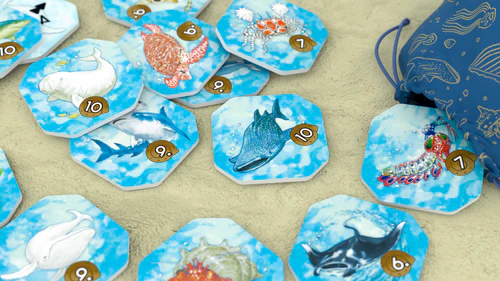
Coral tiles come in 4 different colours (green, red, purple, and yellow) and have colored spots on the sides where fish need to be placed to “complete” the tile and earn points – the number of sides with spots generally equates to the points you will receive; the more fish you need to finish the tile, the more points it is worth. Sealife tiles, on the other hand, score you points for meeting conditions, such as having different fish or different coral in adjacent locations, etc.
Of course, players can earn seashells for completing tiles, and seashells can be spent to break the rules of selection – i.e. you can take a fish from one column and a tile from another. They can also be used to swipe all the tiles or fish from a row, and to move fish within your reef.
This last action is particularly useful, so saving seashells for this is sometimes a really good idea. After you complete a reef tile, you’ll flip the tile over to show the end game points you will earn, and then you are required to put an adjacent fish onto the tile. That means up to three other fish will remain on the board. These fish can be used to satisfy other tiles you are trying to complete.
I think you can now understand the strategy of this game. How do you place tiles and fish to maximize your points. A well placed fish, as long as it is not used to complete a tile, could potentially support up to 4 tiles total if you surround it properly. Planning on doing this, while keeping an eye on potential points from Sealife tiles is really enjoyable, and is the reason I want to keep playing this game again and again.
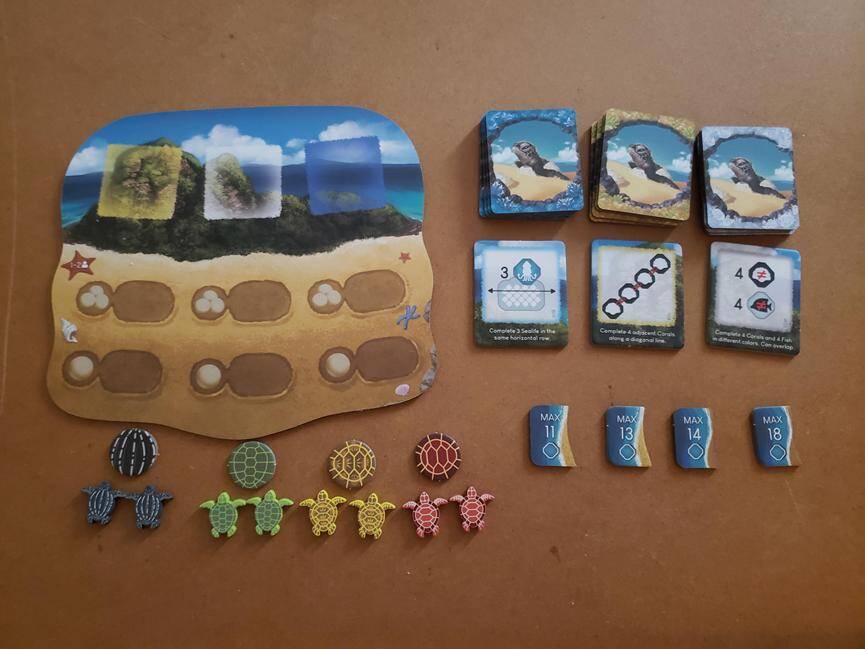
Not only that, but the sheer number of available Sealife tiles you can use in any given game is vast, which means you aren’t likely to play the same game twice as different strategies will need to be implemented. Adding in the expansion content takes the game to the next level, providing new wildlife cards for end game scoring, mid-game goals that you’ll try to complete faster than the other players for maximum points, and a rare fish expansion which, at this point, I haven’t played with yet.
While others might not agree, I think that Shallow Seas is a Cascadia killer, and I’m OK saying it. Cascadia is out, and Shallow Seas is in. The tile laying mechanism here is so rewarding, and despite my hatred for Cascadia, I find Shallow Seas incredibly compelling. Maybe it’s the aquatic theme, but regardless, it’s a fantastic experience that everyone should try, and probably should own!
Oh, and it is an easy to teach, easy to play game too, so it’s widely accessible for all audiences!
 Visit BoxKing Gaming and Get Your Table Today

